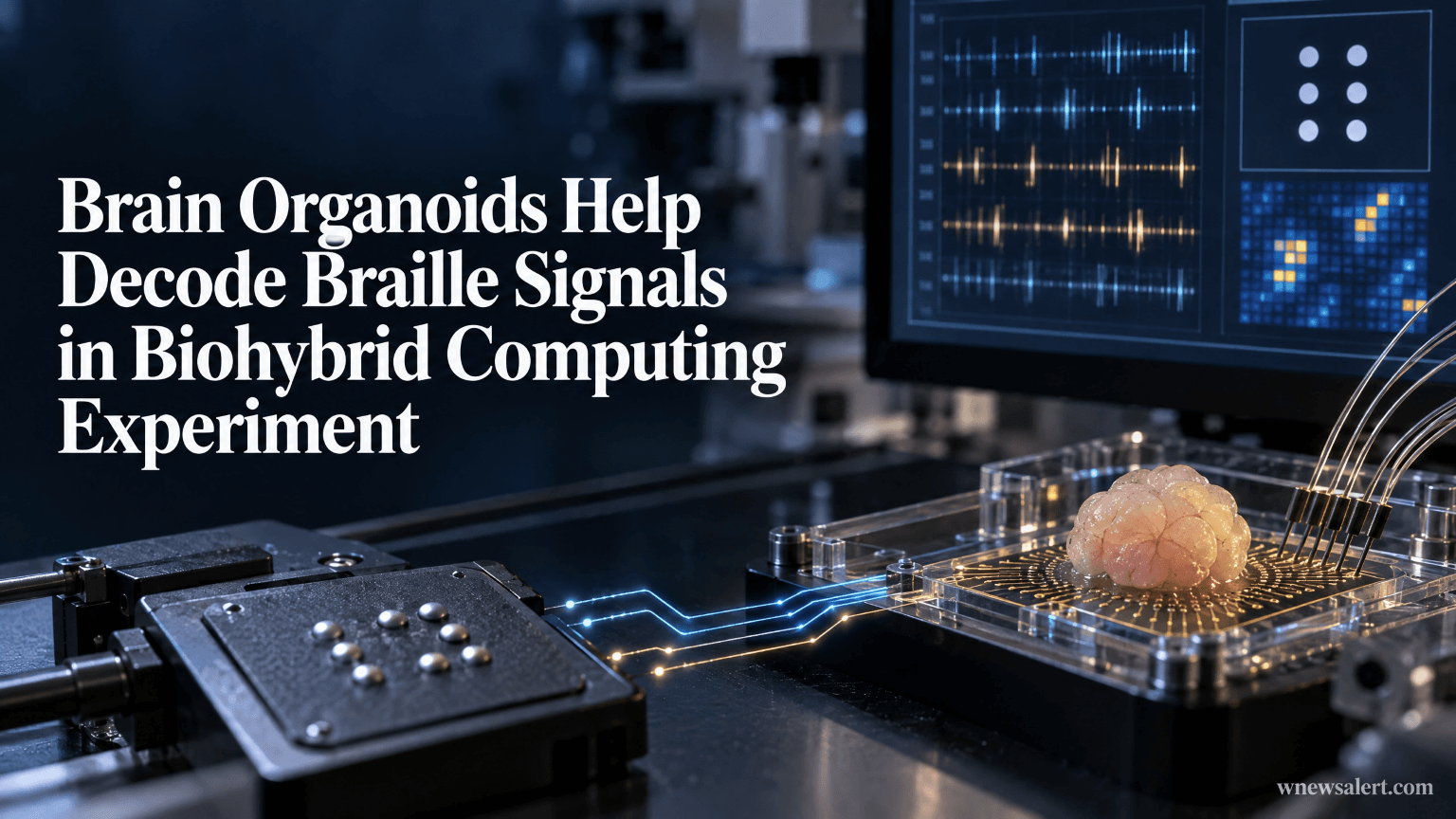
Researchers at the University of Bristol have demonstrated that laboratory-grown brain organoids can process signals corresponding to Braille letters in an experimental biological-electronic computing system.
The study, published in Frontiers in Artificial Intelligence on 16 October 2026, used neural organoids connected to a tactile sensor through electrical stimulation. A computer then analysed the resulting neural activity to classify the patterns associated with different letters.
According to the University of Bristol, a machine-learning classifier identified Braille letter patterns with an average accuracy of 61% when responses from a single organoid were used. Combining responses from three organoids increased the reported accuracy to 83%.
The findings offer an experimental demonstration of how biological neural tissue might be integrated into computing systems. They do not show that the organoids can read or understand Braille in the human sense.
How the experiment worked
The researchers placed human forebrain organoids on multielectrode arrays, which allowed them to deliver electrical stimulation and record neural responses.
A tactile sensor first recorded patterns associated with the 26 letters of the Braille alphabet. Those inputs were converted into electrical stimulation patterns and presented to the organoids. The team then used a support vector machine, a type of machine-learning algorithm, to classify the recorded neural activity.
The three-organoid arrangement performed better than a single organoid in the reported tests. The researchers suggested that differences in the organoids’ neural connections, developmental states and ongoing activity may have allowed their responses to provide complementary information.
The team also tested the system with artificially obscured signals. Under those experimental conditions, decoding the organoid responses was more robust than classifying the noisy inputs directly without the organoids.
The results are specific to the experimental setup and the classification task used in the study. They do not establish that the approach will perform equally well with other kinds of tactile information or in practical computing applications.
What the findings do — and do not — show
The researchers explicitly state that the experiment did not demonstrate learning over time or long-term changes in the organoids. Instead, it showed that tactile information could be encoded, processed through the biological tissue and decoded from the resulting neural activity.
The organoids were less than one millimetre across and lacked several structures found in a human brain. The experiment does not demonstrate consciousness, human-like understanding or the ability to learn Braille through experience.
Biohybrid computing combines biological components with electronic systems. Researchers are investigating whether these arrangements could eventually offer useful approaches to processing information, including possible energy-efficiency benefits. Such benefits have not been established for practical systems by this experiment alone.
The next research challenge is to test more varied inputs and more demanding tasks. The Bristol team has identified tactile features such as textures and edges, as well as experiments involving feedback, as possible directions for future work.
For now, the result is a proof of concept: a biological-electronic system can process signals associated with Braille patterns well enough for a computer to classify them with measurable accuracy.
Sources: University of Bristol — research summary · Frontiers in Artificial Intelligence — original study